


“It was the song of all the promises I failed to keep. And it told me I don’t really want to go home.”
Those are the words of Odysseus after hearing the Sirens’ song in Christopher Nolan’s recent film adaptation of The Odyssey.
The words don’t appear in Homer’s original epic. Nolan wrote them for the screenplay, and they have haunted me ever since I watched the film last week.
The scene is familiar to anyone who knows Homer’s epic.
Odysseus and his crew are passing the Sirens on their voyage home after the war in Troy. The Sirens sing an enchanting song that causes sailors to lose their minds, leap overboard, and remain transfixed as their bodies decay among piles of bones.
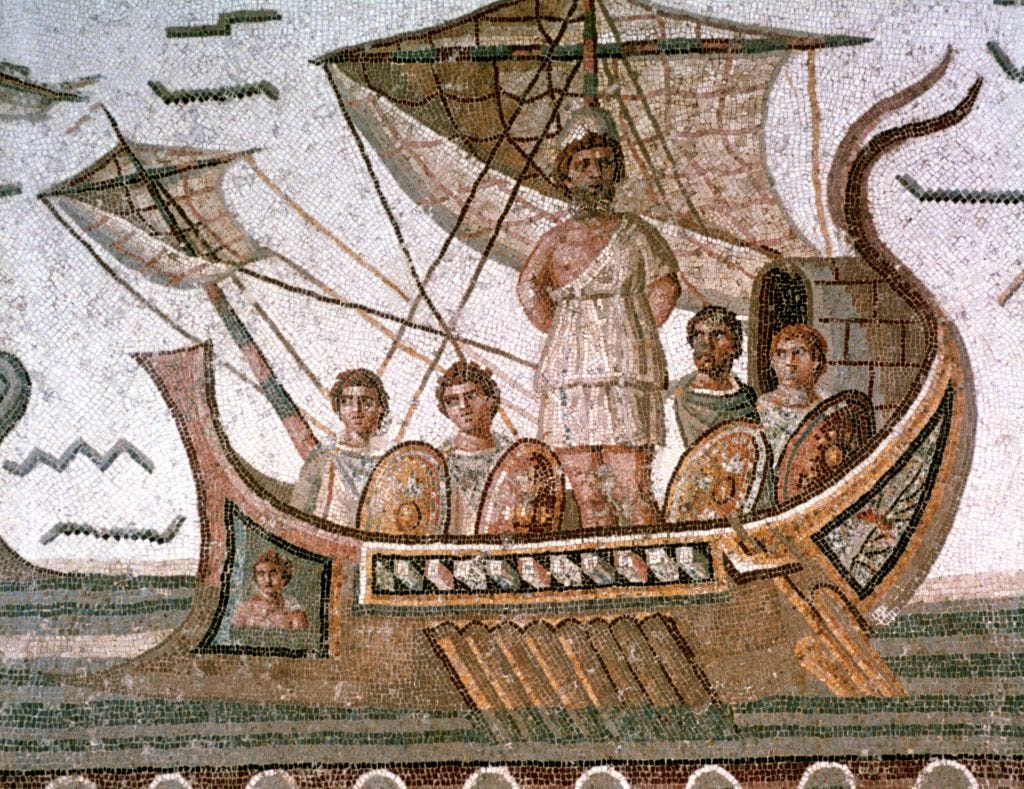
Odysseus gives his crew wax to place in their ears so they cannot hear the alluring song. But he insists on hearing it himself. He orders his men to bind him tightly to the mast so that, no matter how desperately he begs, they will not release him.
What follows is, to me, the emotional high point of the film.
As the ship approaches the Sirens, Odysseus is first enchanted by the song, then heartbroken, and finally writhing in agony as its melody becomes unbearable.
In Emily Wilson’s direct translation, the Sirens essentially promise: “Come here, famous Odysseus… no one has ever sailed past us without listening to our sweet song… we know everything that happened at Troy.” They tell Odysseus that he’ll learn “all that comes to pass upon the fruitful earth.” Their temptation is intellectual as much as sensual.
In Nolan’s film, after they pass the Sirens, a crew member asks him what he heard, and he replies:
“All the things you want it to be. Then, all the things you wish you never wished for.
It was the delicious itch you go to scratch but find it’s under the skin, you can’t reach it. So the delicious itch becomes unbearable.
It told you what you most want…is what you most can’t have.
And what you most can’t have…is what you already had...and lost...
It was the song of all the promises I failed to keep. And it told me I don’t really want to go home.”
Homer presents the Sirens as offering omniscience: We know everything. Nolan reimagines them as offering perfect self-knowledge. Instead of saying, “We know all things,” they seem to say, “We know you—your regrets, your losses, and your deepest desires.”
The new interpretation caught me off guard. It felt like a cascade of salt poured into my deepest wounds. Every word was familiar. Every sentence had already been seared into my heart.
Recently, a good friend of mine, Cobus Pienaar, asked his LinkedIn readers what most weighs us down.
There were many thoughtful responses, but I knew mine before I read any of them:
Failing to always live up to the expectations that I—and others—have for me. Every failure seems to stay with me, accumulating into an almost unbearable weight.
The times I disregarded someone in need.
The times I haven’t truly listened to, seen, or acknowledged another living soul.
The times I chose self-preservation over us-preservation.
The times I’ve lied to or withheld the truth from others—and from myself.
The times I’ve coveted what I shouldn’t.
The times I’ve chosen fear over love.
The loss of relationships, opportunities, respect, integrity—and the relentless call of regret that never seems to leave—have accumulated on my soul like barnacles on the hull of an old ship.
The Odyssey is fundamentally a story about loss. Lost companions. Lost youth. Lost innocence. Lost identity. Lost years. Lost home.
Odysseus fails so many people. Every crewman he leads dies. He defies Zeus and helps create the conditions that lead to the slaughter of Troy. He remains with Calypso for seven years, refusing to face his mistakes, while his wife, Penelope, waits twenty years without a husband and his son, Telemachus, grows up without a father.
Throughout The Odyssey, Odysseus longs for home, yet his own choices repeatedly delay his return. By the time he finally reaches Ithaca, twenty years have passed. Home has become almost mythical. At one point, in a conversation with Calypso, he suggests that perhaps he no longer deserves to go home.
Odysseus eventually recovers his kingdom—sadly, again soaked in blood—but he never recovers the twenty years stolen by war and wandering. The unintended consequences of his actions continue to haunt him, even after finally returning home. Shortly afterward, he leaves again, traveling west to honor the dead and continue seeking redemption.
What Song Are You Listening To?
I’m sure the Sirens’ song represents different things to different people. We all have our vices, and the Sirens sing to them.
For me, it is the voice that gathers every failure, every disappointment, and every promise left unfulfilled into a single narrative: “This is who you are”
And perhaps the cruelest part of the song is that it convinces us we no longer deserve the very thing we long for.
Home.
Peace.
Belonging.
Grace.
That song has often kept me from embracing my strengths. It has tempted me to run from intimacy and vulnerability and to make myself smaller than I am out of shame. Nolan somehow gave a name to the voice in my head that, like Odysseus, has kept me far from home.
The irony is that the teacher, prophet, and Messiah I follow sings a radically different song.
Again and again, Jesus refuses to define people by their failures. Peter denies him three times, yet Jesus entrusts him to feed his sheep. The woman caught in adultery is not condemned. The prodigal son is embraced before he can even finish his confession.
Jesus does not ignore failure. Yet he refuses to let failure become identity.
The Sirens whisper: “You are the sum of the promises you failed to keep.”
Jesus replies: “Come to me, all who labor and are heavy laden, and I will give you rest.”
I suspect it is a lifelong practice to learn to recognize which song we are listening to—to believe that liberation begins when we stop listening to the voice that endlessly rehearses our failures and begin listening instead to the voice that reminds us grace is stronger than regret.
What song are you listening to?
The one that keeps you wandering?
Or the one that calls you home?
Upcoming Event
September 12: A Day For Us Conference in Provo, Utah
I’ll be a Keynote Speaker at A Day for Us: A One-Day Conference with Tools for Couples, Parents, and Partners.
A Day For Us is a practical, skills-based conference for Utah couples designed to help life partners and co-parents strengthen their relationship in the middle of real life. Grounded in mental health expertise and relational science, this is not just inspiration — it’s tools you can use immediately.
I’d love to see you there!
Peacemakers Needed Conference coming to Washington DC
Waymakers, in conjunction with the LDS Washington DC Temple Visitors Center, is hosting half day event on Saturday, September 19th for a half day event at the Washington DC Temple Visitors Center. Patrick Mason, Chad Ford, Thomas Griffith, Ravi Gupta and Maybree Spilsbury will be speaking and doing workshops. Tickets will be available for this free event next week. But mark you calendars now!
Join the Fourth Transformative Mediation Certification Cohort
I’m excited to invite you to join the fourth cohort of the Transformative Mediation Certification Program a 40-hour training for a select group of Utah’s leading mediators, attorneys, social workers, educators, and change agents:
Fourth Cohort
Law & Justice Center, SLC, UT
November 12-14, 2026 (30 hours in-person)
Tuition: $1500
I’d be honored to have you join me in this next select cohort, helping set the standard for transformative mediation across Utah and beyond.
Participants who complete the program will receive a Professional Certificate in Transformative Mediation jointly awarded by Utah State’s Heravi Peace Institute, Utah Dispute Resolution, and Disagree Better as well as up to 40 hours of CLE credit or Social Work Continuing Education Credit.
Wrote one participant after the training:
Each person here has been in training ... to be a highly skilled neutral, a space maker, and transformative mediator, someone who is now able to help parties in conflict as they transform from those destructive patterns of continuing conflict to more peaceful paths (respectful dialogue, understanding), and especially as parties eventually employ for themselves (w/o a mediator’s assistance) the tools (and communication devices) of peacemaking. Think of a world abundant with trained, enthusiastic, dedicated and trustworthy peacemakers! Think of the multiplier effect. Everyone came away from Saturday’s concluding session a better person, a more insightful practitioner, and a committed leader who will choose to promote this meaningful practice. Transformative can show up in families, classrooms, communities, workplaces, courts, cases, industries, sectors and any imaginable format throughout the country. Indeed, the better we dialogue, and the better we (respectfully) disagree, the better our whole world will be.