

A Declaration of Interdependence
America was born in a declaration of independence. Its future may depend on a declaration of interdependence.

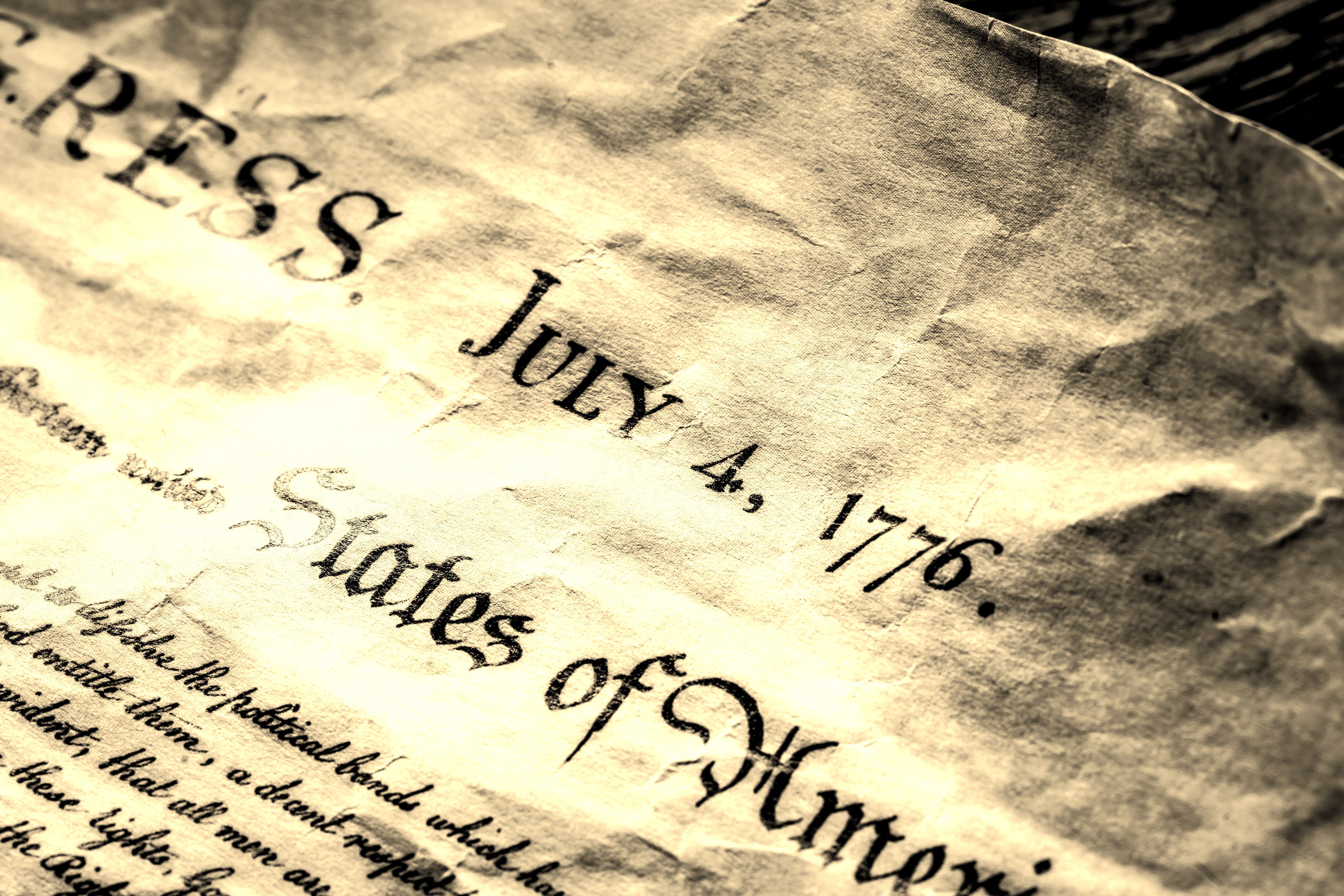
Two hundred and fifty years ago, when Americans declared their independence, they did so from a king, not from each other.
Thomas Jefferson may have drafted the words, but the final product was shaped by John Adams, Benjamin Franklin, and ultimately the Continental Congress. Independence, ironically, was a collaborative effort. It was forged through disagreement, persuasion, compromise, courage, and a commitment to one another.
The document’s title includes these lines: “The unanimous Declaration of the thirteen united States of America.” The document contained pledges of mutual obligation, and the signers promised to risk “our Lives, our Fortunes and our sacred Honor” to create a sacred union.
The Declaration of Independence was also a Declaration of Independence.
Have we forgotten? Too often, the American story focuses on autonomy. To be American is to be self-reliant, self-made, and beholden to no one. Independence has been elevated from political separation to an almost mythic cultural idea. Too often, freedom is imagined as freedom from one another as opposed to the freedom to pursue happiness and liberty together.
From Self-Preservation to Us-Preservation
In my book Dangerous Love, I spend a lot of time writing about the human instinct toward self-preservation and how it leads to destructive conflict. When we feel threatened, our instincts to protect ourselves, our people, our identity, and our story cause us to divide the world into those who are with us and those who are against us. People become labels to us: liberals and conservatives, believers and unbelievers, oppressors and victims.
The Jewish philosopher Martin Buber described two fundamental ways of being in the world: I–It and I–Thou. My friend Jim Ferrell writes in his brilliant book You and We, that we often miss something essential in Buber’s writings: the hyphen. There is no I apart from relation.
“I” becomes “I” in the space between us. How I see you shapes who I become, and how you see me shapes how you become. Reducing you to a label diminishes not only you. I also me. When I encounter you as a person and allow your humanity to pierce mine, something changes in both of us.
The hyphen is everything. It is the space where people meet. It is sacred ground.
Seeing people as people isn’t a tool. It isn’t being nice. It isn’t even about civility. It is recognizing the fundamental importance of relation. It is the recognition that self-preservation cannot be divorced from us-preservation. There is no me without you.
Martin Luther King Jr. wrote from Birmingham jail that we are “caught in an inescapable network of mutuality, tied in a single garment of destiny.” Buber’s hyphen is another way of expressing that. We are not, and can never be fully independent. We are connected, and the key to deep, meaningful, thriving relationships and constructive conflict is understanding that deep in our bones.
We become who we are through other people. Families and neighbors. Friends and enemies. The people who love us. Who challenge us. Who forgive us. Who won’t grant us grace. Our identities are never formed in a vacuum. They are formed alongside others. Whether we like it or not.
The people we love and the enemies we want to vanquish? They are part of us. They are already part of us. It is difficult, in times of conflict, to recognize those bonds. It’s even harder to embrace them and take responsibility for them. The fabric that is tearing is never just them. It is always us.
The Fragile Threads of Union
I think the founders understood this. The thirteen colonies were fraught with differences — cultural, religious, economic, geographic. They decided there was good in embracing them and doing something together instead of going out on their own.
We shouldn’t pretend that their disagreements were not profound and intense. We can’t hide from the powerful moral contradictions that they faced. They declared that “all people were created equal: while continuing to practice slavery.” So many other groups, including women and indigenous people, were deliberately excluded from the political practice.
Sadly, the promise of the Declaration strayed significantly from the realities on the ground.
Some will see that as too great of a moral failure. Nevertheless, I think one way to look at the Declaration was to say that it gave us a language and a moral marker of what we could be. So many great Americans have worked for centuries to widen the circle of us. To help us to continue to build something better.
Of course, that struggle nearly destroyed the country. Less than a century after the Declaration, Americans fought a Civil War over many of these issues.
Abraham Lincoln understood that, at its core, the Civil War was relational. In his First Inaugural Address, he called upon our “ better angels of our nature” and reminded Americans that we are “not enemies, but friends.” Lincoln led a war to end slavery. However, he saw in his enemy people to be reconciled with. The union was still worth preserving.
When we are struggling with conflict and the issues at stake seem to be fundamental to our values, the question remains: How do we fight for justice without surrendering the possibility of a future us?
That continues to be the question.
Polarization isn’t a question of disagreement. We need disagreement to build a healthy democracy. The real danger lies in a feeling of contempt toward those we disagree with. When we see our fellow citizens as enemies who are dangerous, evil, or beyond redemption, we risk the union that made our country possible in the first place. It is possible for relationships and communities to survive passionate disagreement. We cannot survive a loss of a shared “us.”
Our political discourse and the algorithms that dominate how we consume our news tell us the only solution is to silence, punish, or even get rid of those who don’t share our values or beliefs.
They often encourage us to dispose of difficult relationships. To cut off our family, friends, neighbors, or congregants that don’t think or believe the same way we do. They warn us that those relationships are “toxic.” Yet a country and a culture in which every difficult relationship becomes disposable will eventually dispose of democracy altogether.
At the heart of the American experiment is the belief that people with different backgrounds, beliefs, and values can share a country and not only tolerate each other but thrive.
Freedom requires interdependence.
America thrives on dangerous love.
The Sacred Art of Reconciliation
The good news. There are so many passionate, gifted people who are heeding the call of interdependence.
My friend and Waymakers colleague Patrick Mason recently called on us to “declare independence from enmity.” A Declaration of Interdependence calls upon us to remember what connects us to each other. Patrick asks us to remember and be alive to the things that cause disconnection: fear, contempt, tribalism, and the lack of love for neighbor and stranger.
At Waymakers, we’ve been able to work closely with and learn from organizations like Disagree Better, Withiii, the Arbinger Institute, PeacePlayers, Braver Angels, One America Movement, Interfaith America, Living Room Conversations, the Dignity Index, and Mormon Women for Ethical Government. Their approach may be different (and that, in and of itself, is a good thing); however, the core belief that we can do better in navigating our conflicts and staying connected lies at their core. They understand that democracy work is relational; we can disagree without contempt, and mercy, reconciliation, curiosity, and kindness are not weaknesses.
And while these organizations do important work, the most important work happens from everyday people gathering in their homes and their communities, and finding ways through their differences on a relationship at a time. Every time a human being refuses the invitation to contempt and decides that the issues that divide us shouldn’t define us, they declare their interdependence.
Much of my work over the past few years has been in religious communities because I believe they are among the most important places we can learn some of the most difficult practices of interdependence. While they are far from perfect, some of their core values, including the practice of forgiveness, exercising influence without coercion, the importance of community, welcoming the stranger, binding the wounds of disappointment and trauma, and the pursuit of truth, are critical to us navigating conflict better. Our congregations can be and need to become schools of interdependence.
As a Christian, I believe that these issues lie at the heart of Jesus’s ministry. Jesus gathered people who would not ordinarily have belonged together and asked them to become a community. He crossed boundaries, ministered to the outcast, forgave the condemned and his enemies, and while inviting his followers to follow his example. Paul described the work of Jesus as breaking down “the dividing wall of hostility.”
My own Latter-day Saint tradition teaches that “no power or influence can or ought to be maintained by virtue of the priesthood,” except through “persuasion,” “long-suffering,” “gentleness and meekness,” “love unfeigned,” kindness, and pure knowledge (Doctrine and Covenants 121). It is both a radical and beautiful vision. Influence does not flow from domination or control. Enduring power comes not through force and domination, but through persuasion, patience, gentleness, love, and truth.
What would our congregations look like if they became laboratories for that kind of power? Can our convictions invite us to learn how to persuade, repair, and create community, rather than manufacture fear, resentment, and the building of walls?
Completing the Declaration
Interdependence does not mean abandoning truth, justice, accountability, or difference. Interdependence is not passive and doesn’t mean we can’t stand for our values or truth. It does not ask victims to remain in danger or oppressed people to accept oppression.
Interdependence invites us to pursue justice without surrendering the humanity of those with whom we struggle, to resist evil without becoming consumed by hatred, and to build a world in which human dignity is not reserved for our side.
Independence is not diminished by interdependence. It is made possible by it. It completes it. We become free not only when we are left alone, but when we are seen, heard, respected, and included in a common life.
Donna Hicks, in her book Dignity, makes this connection between dignity and freedom when she writes, “The glue that holds all of our relationships together is the mutual recognition of the desire to be seen, heard, listened to, and treated fairly: to be recognized, understood, and to feel safe in the world. When our identity is accepted and we feel included, we are granted a sense of freedom and independence and a life filled with hope and possibility.”
Freedom without relationship eventually becomes isolation. The Declaration begins with political separation from England and a monarchy, but it wasn’t meant to separate us.
Do we believe there is still an “us” worth preserving?
If there is, then perhaps a Declaration of Interdependence begins with four commitments:
At home, choose relationship over being right. Whatever the principle you are trying to uphold, remember the deeper principle of interdependence and how it relates to your parents, your partner, your children, and your extended family. If you must disagree, reaffirm the relationship first. Assert, before you disagree, that the bond that holds you together is unbreakable, even in difference. While our political beliefs matter deeply and help make us who we are, they are not all we are, nor do they solely define “us.”
In our communities, choose curiosity over persuasion. Before you disagree, make sure you not only understand what you are disagreeing about, but who you are disagreeing with. Do you know their story? Do you know the “why’s” that have created their beliefs? Break algorithms. Find people who don’t share your beliefs and break bread with them. Start learning and practicing the skills that democracy requires.
In our congregations, practice the sacred art of reconciliation. Don’t let politics subsume the best of our religious and wisdom traditions. Help our churches, synagogues, mosques, temples, sanghas, and sacred communities become places of learning that teach us how to repair what has been broken, welcome those who are downtrodden, exercise influence without coercion, and find the grace to forgive those that have hurt us.
In the world, turn first. Don’t wait for the “other side” to go first. Quit using their violation of these principles to justify your own. Find the courage to address the major issues of our day — climate, migration, war, technology, disease, poverty, and peace — with openness, curiosity, and a desire to find solutions that work for everyone.
The Declaration of Independence ended with a pledge to one another. Our lives are bound together. Our future is bound together.
Will we continue to deny those bonds or take responsibility for them? Will we preserve only ourselves, or rediscover an us worth preserving?
The American experiment began with a declaration of independence.
Its future may depend on whether we can also learn to declare our interdependence.